Perianal Crohn's.
Plain-language, evidence-based information about perianal Crohn's disease, fistulas and abscesses around the anus, how they're treated medically and surgically, and how to live well.
 Rectal inflammation is common
Abscess, a pocket of infection
Fistula, a tunnel to the skin
Fissures & skin tags at the anus
Rectal inflammation is common
Abscess, a pocket of infection
Fistula, a tunnel to the skin
Fissures & skin tags at the anus
Types of perianal fistula
Most perianal Crohn's fistulas are classed as simple or complex. The distinction guides how aggressively they're treated and whether surgery beyond a seton is needed.
| Feature | Simple | Complex |
|---|---|---|
| Anatomy | ||
| Tracts | Single, low | Multiple or high |
| Sphincter involved | Little | Substantial |
| Openings | One | May be several |
| Abscess | Uncommon | Often present |
| Management | ||
| Seton drainage | Sometimes | Usually needed |
| Biologics | Often | Nearly always |
| Surgery | Fistulotomy may be safe | Staged, sphincter-sparing repair* |
* Complex fistulas are repaired with sphincter-sparing techniques (advancement flap, LIFT, glue/plug, or newer cell therapies) to protect continence.25–28 Seton: a soft drain looped through the tract to keep it open and reduce the risk of abscesses while medical therapy works.23, 24 Classification often clarifies once the anatomy is mapped by exam under anesthesia or MRI.10, 11
Frequently Asked Questions
Quick, plain-language answers to the questions we hear most.
What is a perianal fistula?
A perianal fistula is a small tunnel that forms between the inside of the anal canal and the skin near the anus. In Crohn's it results from inflammation, and it can drain fluid or pus. Many are “complex”, more than one tunnel, or a tract higher up the muscle, which guides how they are treated.6, 7
Is perianal Crohn's common?
It is common. Up to about a third of people with Crohn's develop perianal disease at some point, and for some it is the first sign of Crohn's.1–3 It is not a sign that you did anything wrong.
When should I worry about an abscess?
An abscess is a walled-off pocket of infection. Increasing pain, swelling, redness, fever, or a sudden change in drainage can signal one, and it usually needs prompt drainage, sometimes before the fistula itself is treated.8, 9 Contact your care team rather than waiting; early drainage relieves pain and protects healing.
Which medicines treat perianal Crohn's?
Antibiotics such as metronidazole or ciprofloxacin help settle infection,15, 16 and anti-TNF biologics such as infliximab are the best-studied drugs for healing Crohn's fistulas17–19, often combined with an immunomodulator.20–22 Your gastroenterologist tailors this to you.
What is a seton and why do I need one?
A seton is a soft surgical thread looped through a fistula to keep it draining. It prevents abscesses from forming and protects the muscle while medicines work to heal the inflammation.23, 24 Setons are one of the most common first steps and are often left in for months.
Will I need surgery?
Most people with perianal Crohn's have at least a minor procedure. Draining an abscess or placing a draining seton.23, 24 Definitive sphincter-preserving repair (LIFT, advancement flap, or a plug) is considered once inflammation is controlled, and surgeons work hard to preserve the muscles that control continence.25–28
Can a fistula heal completely?
Yes. Many fistulas heal or become symptom-free with the combination of a draining seton, effective anti-TNF therapy, and a sphincter-preserving procedure.17–19 It often takes time and a coordinated GI–surgery plan, and some fistulas recur, so ongoing follow-up matters.44–46
What does it mean for a fistula to be “healed”?
In 2026, healing is judged by a pelvic MRI, not just by how the area looks or feels. A tunnel can look quiet on the outside while it is still active deep down, so an MRI is used before and after any repair to confirm things have truly healed.33–35 Healing also takes time: often many months of seton drainage plus medicine before a repair is even considered.
Will I need an ostomy (stoma)?
Most people do not need one. When perianal disease is severe, a temporary stoma can divert stool away from the area to let it settle and heal, and for many people it brings real relief from pain and constant drainage.36, 37 It is usually meant to be temporary, though in some cases it becomes permanent. If a stoma is ever discussed, your team will walk you through exactly why and what to expect.
Could surgery to remove the rectum ever be needed?
Rarely, and only for perianal Crohn's that will not respond to medicines and drainage despite everyone's best efforts.38–40 The aim is always the same, a comfortable, dry, pain-free bottom and a better quality of life. If this ever comes up, it is a carefully shared decision, never a rush.
What is Perianal Crohn's Disease?
Perianal Crohn's is Crohn's disease that affects the area around the anus. The inflammation can create small tunnels (fistulas), pockets of infection (abscesses), tears (fissures), or skin tags. It affects up to about a third of people with Crohn's at some point,1–3 and for some people it is the first sign of Crohn's.4, 5
Fistula
A fistula is an abnormal tunnel that forms between the anal canal and the skin nearby (or another organ). It can drain fluid or pus and may be uncomfortable. Many are “complex,” with more than one branch or a tract higher up the muscle.6, 7
Abscess
An abscess is a walled-off pocket of infection. It often causes pain, swelling, and fever, and usually needs to be drained promptly, sometimes before the fistula itself is treated.8, 9
Why It's Treated as a Team Effort
Perianal Crohn's responds better when the gastroenterologist (medicines) and the colorectal surgeon (drainage and procedures) work together. Treating the gut inflammation and the local problem at the same time gives the best chance of healing while protecting continence.12–14
How Perianal Crohn's Is Treated
Treatment almost always combines medical therapy (to calm the inflammation) with procedures (to drain infection and help tunnels heal). The goal is simple to say and takes teamwork to reach: a comfortable, dry, pain-free bottom, while protecting the muscles that control continence.31, 32
The plan usually follows an order
Perianal Crohn's is treated in steps, and the order matters. Trying to "fix" a tunnel before the area is ready is what leads to setbacks, so your team works through it in sequence:
- 1. Settle the infection first. Drain any abscess and place a seton so tunnels stay open and calm. This step comes first, always.23, 24
- 2. Calm the inflammation. Medicines, often an anti-TNF biologic, heal the Crohn's itself. A repair only holds once the disease is quiet.17–19
- 3. Repair once it's ready. A sphincter-preserving procedure is offered after the area has healed, confirmed on MRI, not just by how it looks or feels.31, 32
Medical therapy
Antibiotics (metronidazole, ciprofloxacin) settle infection;15, 16 anti-TNF biologics such as infliximab are the best-studied drugs for healing Crohn's fistulas,17–19 often alongside an immunomodulator.20–22
Seton drainage
A soft surgical thread (seton) is looped through the fistula to keep it draining and prevent new abscesses while the medicines work. It's a very common first step.23, 24
Definitive procedures
For simple, low fistulas, a fistulotomy may be possible. For complex ones, sphincter-preserving options include the LIFT procedure, an advancement flap, or a fistula plug.25–28
Stem cells
Locally injected mesenchymal stem cells (darvadstrocel) are an option for complex perianal fistulas that haven't healed with standard care.29, 30
Perioperative Optimization
The things you do around your care. Not smoking, gentle daily care, and staying the course. Measurably improve how well perianal Crohn's heals and how well procedures hold.
Stop smoking
Smoking clearly worsens Crohn's and perianal disease, more flares, complications, and surgery. Quitting is one of the most powerful things you can do for your gut and your fistulas.41–43
Diversion & Proctectomy
These are reserved for severe perianal Crohn's that will not respond to medicines and drainage, always a carefully shared decision, never a rush.
Advanced Topics
The rest of this page is written for patients; this section is a concise, evidence-anchored primer on perianal Crohn's disease for trainees and non-specialist providers. Every reference below has been verified against PubMed and links to its record. For the broader surgical evidence base, see Crohnsology.org; for luminal/intestinal disease, see Crohnz.org.
Fistula anatomy & classification
The Parks classification remains the anatomical framework for fistula-in-ano; management of perianal Crohn's is organised around fistula course relative to the sphincter complex.
- Parks AG, Gordon PH, Hardcastle JD. A classification of fistula-in-ano. Br J Surg. 1976;63(1):1-12. PMID 1267867
- Sandborn WJ, Fazio VW, Feagan BG, Hanauer SB. AGA technical review on perianal Crohn's disease. Gastroenterology. 2003;125(5):1508-30. PMID 14598268
Diagnosis & disease mapping
Accurate assessment combines pelvic MRI with examination under anaesthesia; MRI also tracks fistula response to therapy over time.
- Schwartz DA, Wiersema MJ, Dudiak KM, et al. A comparison of endoscopic ultrasound, magnetic resonance imaging, and exam under anesthesia for evaluation of Crohn's perianal fistulas. Gastroenterology. 2001;121(5):1064-72. PMID 11677197
- Van Assche G, Vanbeckevoort D, Bielen D, et al. Magnetic resonance imaging of the effects of infliximab on perianal fistulizing Crohn's disease. Am J Gastroenterol. 2003;98(2):332-9. PMID 12591051
Combined medical & surgical therapy
The evidence base favours a combined approach, seton drainage plus anti-TNF maintenance, over either alone for fistulising disease.
- Sands BE, Anderson FH, Bernstein CN, et al. Infliximab maintenance therapy for fistulizing Crohn's disease (ACCENT II). N Engl J Med. 2004;350(9):876-85. PMID 14985485
Mesenchymal stem-cell therapy
Local injection of expanded allogeneic adipose-derived mesenchymal stem cells (darvadstrocel) achieves durable healing of complex fistulas refractory to conventional therapy.
- Panés J, García-Olmo D, Van Assche G, et al. Expanded allogeneic adipose-derived mesenchymal stem cells (Cx601) for complex perianal fistulas in Crohn's disease: a phase 3 randomised, double-blind controlled trial (ADMIRE-CD). Lancet. 2016;388(10051):1281-90. PMID 27477896
- Panés J, García-Olmo D, Van Assche G, et al. Long-term efficacy and safety of stem cell therapy (Cx601) for complex perianal fistulas in patients with Crohn's disease. Gastroenterology. 2018;154(5):1334-42. PMID 29277560
Sphincter-sparing options (LIFT, advancement flap) and diversion/proctectomy for refractory disease follow society (ECCO/ASCRS) guidance and are individualised; see Crohnsology.org. This digest is educational and does not replace clinical judgement.
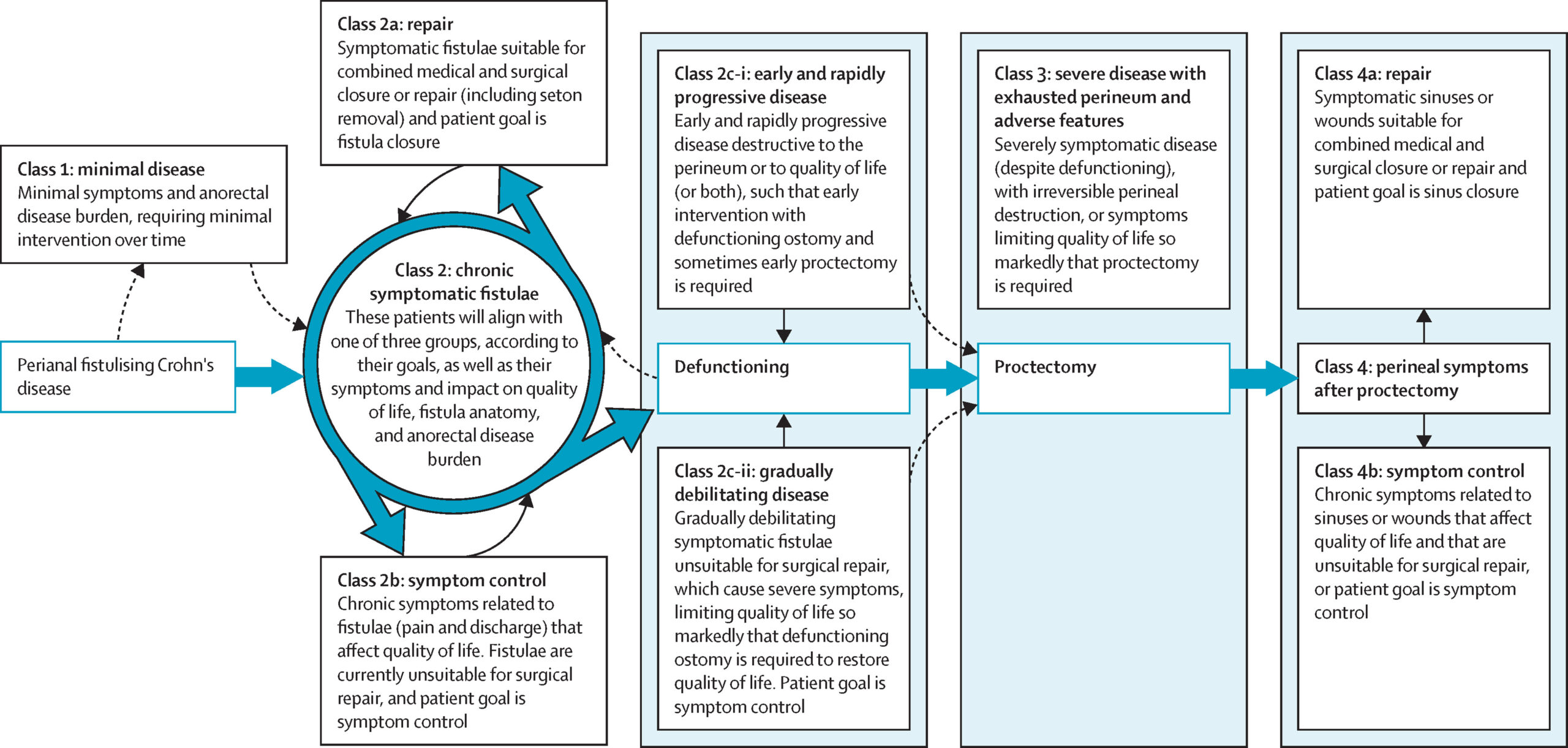
TOpClass: A Modern Map of Perianal Crohn's
TOpClass is a plain, goal-based way doctors group perianal Crohn's disease, developed by an international expert group (the TOpClass Consortium). Instead of labeling fistulas by anatomy alone, it focuses on how the disease is behaving and what you and your team are trying to achieve, so care can be matched to you.
Class 1: Minimal disease
A fistula is present but causing little or no trouble. Often watched or managed conservatively.
Class 2: Active, aiming to improve
The main group: symptomatic fistulas where the plan is to heal or control them. Your team also notes the goal, to repair the tunnel, to control symptoms, or, when disease is progressing, to treat more aggressively.
Class 3: Highly refractory
Severe, heavily-treated disease (a so-called "exhausted perineum") where repair is unlikely. The goal shifts toward relief and protecting quality of life.
Class 4: After the rectum is removed
For the small number who have had the rectum removed (proctectomy) but still have perineal problems, such as a slow-healing wound. The goal is to repair it or control symptoms.
The Complete TOpClass Map
The four classes above are the plain-language version. Here is the full classification your care team uses, including the sub-groups that match treatment to your goals.
Why a shared map helps
TOpClass gives you and your team a shared language to set realistic goals and choose the right next step. It is also used in research, so studies compare like with like, and a major recent focus is defining what "healed" really means on MRI.
TOpClass Research
Key papers from the TOpClass Consortium, newest first (our authors in bold). Each links to its PubMed record.
- Anand E, et al. Defining radiological healing in perianal fistulizing Crohn's disease: a TOpClass global expert Delphi consensus. Clin Gastroenterol Hepatol. 2026. PMID: 40210078.
- Anand E, et al. VALIDATE-PERIANAL: an international real-world multi-centre exploratory validation of the TOpClass definition of a radiologically healed fistula. Insights Imaging. 2026. PMID: 41944984.
- Wanchaitanawong W, et al. Clinical characteristics of isolated perianal Crohn's disease and validation of the TOpClass criteria: a retrospective cohort pilot study. Inflamm Bowel Dis. 2026. PMID: 41719164.
- Hanna LN, … Holubar SD, et al. Perianal fistulizing Crohn's disease: utilizing the TOpClass classification in clinical practice to provide targeted individualized care. Clin Gastroenterol Hepatol. 2025. PMID: 39134293.
- Alipouriani A, … Holubar SD, et al. TOpClass Class 4 perineal Crohn's disease: a systematic review and meta-analysis of perineal wound complication after proctectomy. Inflamm Bowel Dis. 2025. PMID: 39418126.
- Schroeder MK, et al. TOpCLASS expert consensus classification of perianal fistulising Crohn's disease: a real-world application in a serial fistula MRI cohort. J Crohns Colitis. 2024. PMID: 38642332.
- Geldof J, et al. Classifying perianal fistulising Crohn's disease: an expert consensus to guide decision-making in daily practice and clinical trials. Lancet Gastroenterol Hepatol. 2022. PMID: 35325623. The original TOpClass consensus.
The TOpClass Consortium
TOpClass was built by an international group of surgeons, gastroenterologists, radiologists, and patient partners working together to standardize how perianal Crohn's is described and treated.

Search the Perianal Crohn's ResearchLive
6,299 studies on perianal Crohn's disease, 4,042 (64% of records) with open-access full text. Search titles & abstracts, or the full text where available.
Recent abstracts
Ask AI: AI‑Powered Q&A
Ask clinical questions in plain language and get evidence‑based answers with cited sources.
The Evidence Behind This Site
Every statement on pcrohns.org is grounded in the published medical literature. Below, the key points are grouped by topic and linked to the peer-reviewed studies that support them. Sources were retrieved from a curated perianal Crohn's research library and verified against the U.S. National Library of Medicine (PubMed); none are retracted. Last verified July 2026.
The Basics
Perianal disease affects up to about a third of people with Crohn's at some point.1–3
For some people, perianal disease is the first sign of Crohn's.4, 5
A fistula is an abnormal tunnel between the anal canal and the skin; many are “complex,” with more than one branch or a higher tract.6, 7
An abscess is a walled-off pocket of infection that usually needs prompt drainage, sometimes before the fistula itself is treated.8, 9
An exam under anesthesia plus a pelvic MRI map the tunnels precisely to guide treatment.10, 11
Perianal Crohn's responds better when the gastroenterologist (medicines) and the colorectal surgeon (procedures) work together.12–14
Treatment
Antibiotics such as metronidazole and ciprofloxacin help settle infection.15, 16
Anti-TNF biologics such as infliximab are the best-studied drugs for healing Crohn's fistulas.17–19
Anti-TNF therapy is often combined with an immunomodulator.20–22
A draining seton keeps the fistula open and reduces the risk of abscesses while the medicines work.23, 24
Sphincter-preserving options include the LIFT procedure, an advancement flap, or a fistula plug; a fistulotomy may suit simple, low fistulas.25–28
Locally injected mesenchymal stem cells (darvadstrocel) are an option for complex fistulas that haven't healed with standard care.29, 30
The modern approach is sequenced: control infection, calm inflammation, then repair once the area is ready.31, 32
Healing is confirmed on MRI, before and after repair. A tract can stay active while the surface looks quiet.33–35
A temporary stoma can divert stool to let severe disease settle, though it sometimes becomes permanent.36, 37
Rarely, removing the rectum (proctectomy) is needed for disease that won't respond.38–40
Living Well
Smoking clearly worsens Crohn's and perianal disease; quitting is one of the most powerful things you can do.41–43
References
- Tsai L, et al. Epidemiology and Natural History of Perianal Crohn's Disease: A Systematic Review and Meta-Analysis of Population-Based Cohorts. Inflamm Bowel Dis. 2022;28(10):1477-1484. PMID: 34792604.
- Everhov ÅH, et al. Cumulative incidence and prevalence of perianal diseases in patients with inflammatory bowel disease and in the population: a nationwide Swedish study. Scand J Gastroenterol. 2025;60(4):349-354. PMID: 40094394.
- García-Olmo D, et al. Prevalence of Anal Fistulas in Europe: Systematic Literature Reviews and Population-Based Database Analysis. Adv Ther. 2019;36(12):3503-3518. PMID: 31656013.
- Waheed KB, et al. Magnetic resonance imaging findings in patients with initial manifestations of perianal fistulas. Ann Saudi Med. 2020;40(1):42-48. PMID: 32026703.
- Singer AA, et al. Fistulizing Crohn's Disease Presenting After Surgery on a Perianal Lesion. Pediatrics. 2016;137(3):e20152878. PMID: 26908665.
- Tozer PJ, et al. Review article: pathogenesis of Crohn's perianal fistula-understanding factors impacting on success and failure of treatment strategies. Aliment Pharmacol Ther. 2018;48(3):260-269. PMID: 29920706.
- Crippa J, Spinelli A. Evolving management strategies for perianal Crohn's fistulizing disease. Br J Surg. 2022;109(2):147-149. PMID: 34849587.
- Pritchard TJ, et al. Perirectal abscess in Crohn's disease. Drainage and outcome. Dis Colon Rectum. 1990;33(11):933-7. PMID: 2226080.
- Sangwan YP, et al. Perianal Crohn's disease. Results of local surgical treatment. Dis Colon Rectum. 1996;39(5):529-35. PMID: 8620803.
- Schwartz DA, et al. A comparison of endoscopic ultrasound, magnetic resonance imaging, and exam under anesthesia for evaluation of Crohn's perianal fistulas. Gastroenterology. 2001;121(5):1064-72. PMID: 11677197.
- Lo Re G, et al. MR imaging of perianal fistulas in Crohn's disease: sensitivity and specificity of STIR sequences. Radiol Med. 2016;121(4):243-51. PMID: 26643166.
- Wiseman J, et al. A Multi-Disciplinary Approach to Perianal Fistulizing Crohn's Disease. Clin Colon Rectal Surg. 2022;35(1):51-57. PMID: 35069030.
- Geldof J, et al. The Essential Role of a Multidisciplinary Approach in Inflammatory Bowel Diseases: Combined Medical-Surgical Treatment in Complex Perianal Fistulas in CD. Clin Colon Rectal Surg. 2022;35(1):21-31. PMID: 35069027.
- Yassin NA, et al. Systematic review: the combined surgical and medical treatment of fistulising perianal Crohn's disease. Aliment Pharmacol Ther. 2014;40(7):741-9. PMID: 25115149.
- Thia KT, et al. Ciprofloxacin or metronidazole for the treatment of perianal fistulas in patients with Crohn's disease: a randomized, double-blind, placebo-controlled pilot study. Inflamm Bowel Dis. 2009;15(1):17-24. PMID: 18668682.
- Dejaco C, et al. Antibiotics and azathioprine for the treatment of perianal fistulas in Crohn's disease. Aliment Pharmacol Ther. 2003;18(11-12):1113-20. PMID: 14653831.
- Present DH. Review article: the efficacy of infliximab in Crohn's disease--healing of fistulae. Aliment Pharmacol Ther. 1999;13 Suppl 4:23-8; discussion 38. PMID: 10597336.
- Gu B, et al. Higher infliximab and adalimumab trough levels are associated with fistula healing in patients with fistulising perianal Crohn's disease. World J Gastroenterol. 2022;28(23):2597-2608. PMID: 35949350.
- Abdelrehim KMM, et al. Efficacy of Adalimumab Biosimilars in Managing Perianal Fistula in Moderate to Severe Crohn's Disease: A Systematic Review and Meta-Analysis. Clin Ter. 2025;176(6):839-845. PMID: 41267606.
- Steinhart AH, et al. Clinical Practice Guideline for the Medical Management of Perianal Fistulizing Crohn's Disease: The Toronto Consensus. J Can Assoc Gastroenterol. 2018;1(4):141-154. PMID: 31799497.
- Ochsenkühn T, Göke B, Sackmann M. Combining infliximab with 6-mercaptopurine/azathioprine for fistula therapy in Crohn's disease. Am J Gastroenterol. 2002;97(8):2022-5. PMID: 12190171.
- Schröder O, et al. Combining infliximab and methotrexate in fistulizing Crohn's disease resistant or intolerant to azathioprine. Aliment Pharmacol Ther. 2004;19(3):295-301. PMID: 14984376.
- Haennig A, et al. The results of seton drainage combined with anti-TNFα therapy for anal fistula in Crohn's disease. Colorectal Dis. 2015;17(4):311-9. PMID: 25425534.
- White I, et al. Impact of Seton Use on Clinical, Patient-Reported, and Healthcare Resource Utilization Outcomes in Complex Crohn's Perianal Fistulas: A Systematic Literature Review. Inflamm Bowel Dis. 2025;31(6):1556-1566. PMID: 39298676.
- Stellingwerf ME, et al. Systematic review and meta-analysis of endorectal advancement flap and ligation of the intersphincteric fistula tract for cryptoglandular and Crohn's high perianal fistulas. BJS Open. 2019;3(3):231-241. PMID: 31183438.
- van Praag EM, et al. Ligation of the Intersphincteric Fistula Tract and Endorectal Advancement Flap for High Perianal Fistulas in Crohn's Disease: A Retrospective Cohort Study. J Crohns Colitis. 2020;14(6):757-763. PMID: 31696918.
- Gingold DS, Murrell ZA, Fleshner PR. A prospective evaluation of the ligation of the intersphincteric tract procedure for complex anal fistula in patients with Crohn's disease. Ann Surg. 2014;260(6):1057-61. PMID: 24374520.
- Dominguez OH, … Holubar SD, et al. Fistulotomy for superficial or minimal sphincter-involving fistulae in perianal Crohn's disease: do they heal?. Tech Coloproctol. 2026;30(1). PMID: 42128973.
- Garcia-Olmo D, et al. Follow-up Study to Evaluate the Long-term Safety and Efficacy of Darvadstrocel (Mesenchymal Stem Cell Treatment) in Patients With Perianal Fistulizing Crohn's Disease: ADMIRE-CD Phase 3 Randomized Controlled Trial. Dis Colon Rectum. 2022;65(5):713-720. PMID: 34890373.
- Dawoud C, et al. Efficacy of cx601 (darvadstrocel) for the treatment of perianal fistulizing Crohn's disease-A prospective nationwide multicenter cohort study. Wien Klin Wochenschr. 2024;136(9-10):289-294. PMID: 37823920.
- De Gregorio M, et al. A new protocolized treatment strategy optimizing medical and surgical care leads to improved healing of Crohn's perianal fistulas. J Crohns Colitis. 2025;19(1). PMID: 39756400.
- Sordo-Mejia R, Gaertner WB. Multidisciplinary and evidence-based management of fistulizing perianal Crohn's disease. World J Gastrointest Pathophysiol. 2014;5(3):239-51. PMID: 25133026.
- Gecse KB, et al. Results of the Fifth Scientific Workshop of the ECCO [II]: Clinical Aspects of Perianal Fistulising Crohn's Disease-the Unmet Needs. J Crohns Colitis. 2016;10(7):758-65. PMID: 26826183.
- Meima-van Praag EM, et al. Short-term anti-TNF therapy with surgical closure versus anti-TNF therapy alone for Crohn's perianal fistulas (PISA-II): long-term outcomes of an international, multicentre patient preference, randomised controlled trial. EClinicalMedicine. 2023;61:102045. PMID: 37457118.
- van Rijn KL, et al. Fibrosis and MAGNIFI-CD Activity Index at Magnetic Resonance Imaging to Predict Treatment Outcome in Perianal Fistulizing Crohn's Disease Patients. J Crohns Colitis. 2022;16(5):708-716. PMID: 34644395.
- Galandiuk S, et al. Perianal Crohn disease: predictors of need for permanent diversion. Ann Surg. 2005;241(5):796-801; discussion 801-2. PMID: 15849515.
- Gu J, et al. Factors affecting the fate of faecal diversion in patients with perianal Crohn's disease. Colorectal Dis. 2015;17(1):66-72. PMID: 25306934.
- Prien C, Holubar SD. Intersphincteric Proctectomy for Fistulizing Perianal Crohn's Disease. Dis Colon Rectum. 2026. PMID: 41919603.
- Alves Martins BA, et al. Long-Term Complications of Proctectomy for Refractory Perianal Crohn's Disease: A Narrative Review. J Clin Med. 2025;14(8). PMID: 40283631.
- Figg RE, Church JM. Perineal Crohn's disease: an indicator of poor prognosis and potential proctectomy. Dis Colon Rectum. 2009;52(4):646-50. PMID: 19404069.
- Thia KT, et al. Risk factors associated with progression to intestinal complications of Crohn's disease in a population-based cohort. Gastroenterology. 2010;139(4):1147-55. PMID: 20637205.
- Lawrance IC, et al. Crohn's disease and smoking: is it ever too late to quit?. J Crohns Colitis. 2013;7(12):e665-71. PMID: 23790611.
- Inamdar S, et al. Smoking and early infliximab response in Crohn’s disease: a meta-analysis. J Crohns Colitis. 2015;9(2):140-6. PMID: 25518060.
- Makowiec F, Jehle EC, Starlinger M. Clinical course of perianal fistulas in Crohn's disease. Gut. 1995;37(5):696-701. PMID: 8549948.
- Nam K, et al. Predictors of reoperation for perianal fistula in Crohn's disease. J Dig Dis. 2021;22(6):334-341. PMID: 33949127.
- Graf W, et al. Long-term outcome after surgery for Crohn's anal fistula. Colorectal Dis. 2016;18(1):80-5. PMID: 26338142.
Compiled by IBDology. Citations are provided for transparency and education and are not a substitute for advice from your own care team.
About Pcrohns.org
Pcrohns.org is a plain-language, evidence-based guide to perianal Crohn's disease, fistulas, abscesses, setons, medical therapy, surgery, and living well. Perianal Crohn's is frightening and poorly explained, and the evidence that could help often takes ~17 years to reach routine care; Pcrohns closes that gap by pairing the newest perianal-Crohn's literature with a “deep and narrow” AI that answers questions in plain language. It is one of the patient-facing sites in the IBDology family.

This site was created by Stefan D. Holubar, MD, MS, FACS, FASCRS, Professor of Surgery at Cleveland Clinic and the Cleveland Clinic Lerner College of Medicine & Case Western Reserve University. A fellowship-trained colorectal surgeon who specializes in inflammatory bowel disease, he lives with IBD and a J-pouch himself and brings both the surgeon's and the patient's perspective to this work. He is co-PI of the Crohn's & Colitis Foundation IBD-SIRCQ and the ACS-NSQIP IBD Collaborative, founder of the iPouch Consortium, and has authored over 300 peer-reviewed publications.
Dr. Holubar is an employee of Cleveland Clinic, and has the following disclosures: research funding from the American Society of Colon & Rectal Surgeons and the Crohn's & Colitis Foundation, and has no other disclosures or conflicts of interest.